The Core Idea
Today, most street lights run on simple timers — full brightness from dusk to dawn, regardless of what’s actually happening on the ground. A light over a busy crosswalk runs at the same level as one illuminating an empty field. A residential cul-de-sac blazes at the same intensity as a six-lane highway interchange.
Photometrics AI changes that. We analyze the unique context of every single light — its height, optic type, the road geometry it serves, nearby land use, adjacent fixtures whose beams overlap — and calculate the precise dimming level that delivers the right amount of light, in the right place, at the right time.
This isn’t blanket dimming. It’s not “reduce everything by 30% after midnight.” It’s per-luminaire optimization — a custom instruction for each fixture, grounded in physics and real-world GIS data, verified against IES lighting standards.
The result: energy savings of 25-50% while maintaining or improving lighting quality where it matters most.1
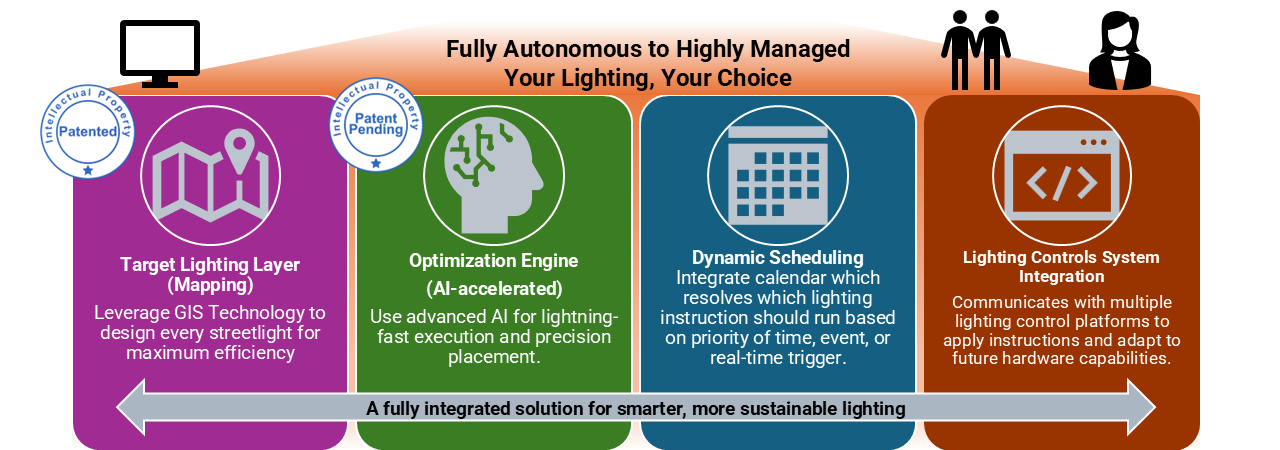
Four integrated components — from GIS mapping to your existing lighting controls
The Four Components
Target Lighting Layer
GIS-based maps specifying desired illumination levels for every zone in your coverage area.
- Crosswalks: 20 lux
- Major roads: 11-18 lux
- Local streets: 7 lux
- Sidewalks: 2 lux
- Building footprints: 0 lux
Dynamic variations for Halloween, late night, migratory bird protection, demand response, and special events.
Optimization Engine
AI-accelerated system that finds the optimal dimming level (0-100%) for each luminaire.
- Tests thousands of configurations in minutes
- Accounts for overlapping beam spreads
- Uses real-world geometry (slopes, intersections, mast arm positions)
- Generates in-house labeled training data
Human eyes cannot perceive brightness changes under 20%—significant optimization headroom exists.
Dynamic Scheduling
Priority-based calendar resolving which lighting instruction runs at any given time.
Priority hierarchy (highest to lowest):
- Emergency dispatch (CAD integration)
- Grid emergency (demand response)
- Transportation safety
- Crime prevention
- Special events
- Environmental protection (BirdCast)
- Default operating profile
Higher priorities are never degraded for lower ones.
NLC Integration
API communication with your existing lighting control platforms.
We receive:
- Asset inventory
- Luminaire locations
- IES file assignments
- Current schedules
We send:
- Optimized per-luminaire dimming
- Schedule assignments
Currently integrated with 2 major lighting control systems.
Processing Speed
For a 2,000-light project:
- Traditional method: Days to weeks
- Photometrics AI: 3-5 minutes2
Standards Compliance
Photometrics AI optimizes to meet:
- ANSI/IES RP-8 (US roadway lighting)
- CIE 115 (International)
- AS/NZS 1158 (Australia/New Zealand)
Typical compliance rate: 91-97% of calculation points meet or exceed standards.3
What Photometrics AI Adds (vs. NLCs alone)
Your networked lighting controls provide the infrastructure—communications, metering, health monitoring, on/off control.
Photometrics AI adds the intelligence:
- Photometric optimization based on actual physics
- Per-luminaire dimming (not one-size-fits-all)
- Standards compliance verification
- Dynamic context-aware scheduling
- Multi-priority resolution
25% savings from per-luminaire optimization during standard evening operation; up to 50% during low-traffic early-morning hours (1–5 AM). Based on Photometrics AI pilot modeling. ↩︎
Photometrics AI internal benchmarking on a 2,000-luminaire dataset. ↩︎
Photometrics AI internal pilot modeling. Compliance measured against ANSI/IES RP-8 calculation points. ↩︎